A comprehensive suite of privacy-preserving mechanisms built into your data pipeline.
https://www.gotrust.tech
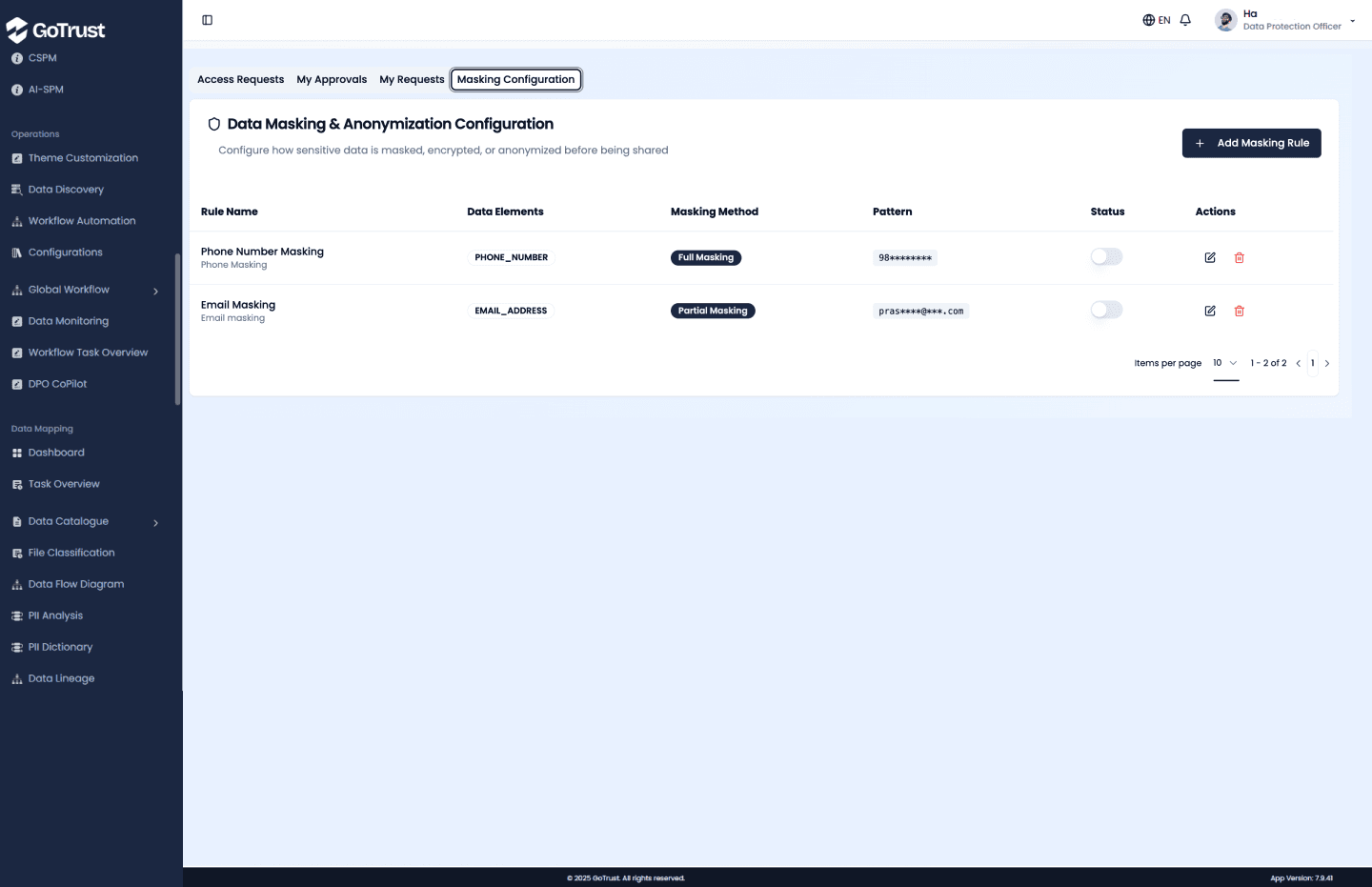
Every technique works together within GoTrust's governance framework.
Data Anonymization
Irreversibly transform personal identifiers so individuals cannot be re-identified — even against external auxiliary data.
Data Tokenization & Minimization
Replace sensitive values with format-preserving tokens and enforce purpose-based rules that limit which fields are ever collected, stored, or shared.
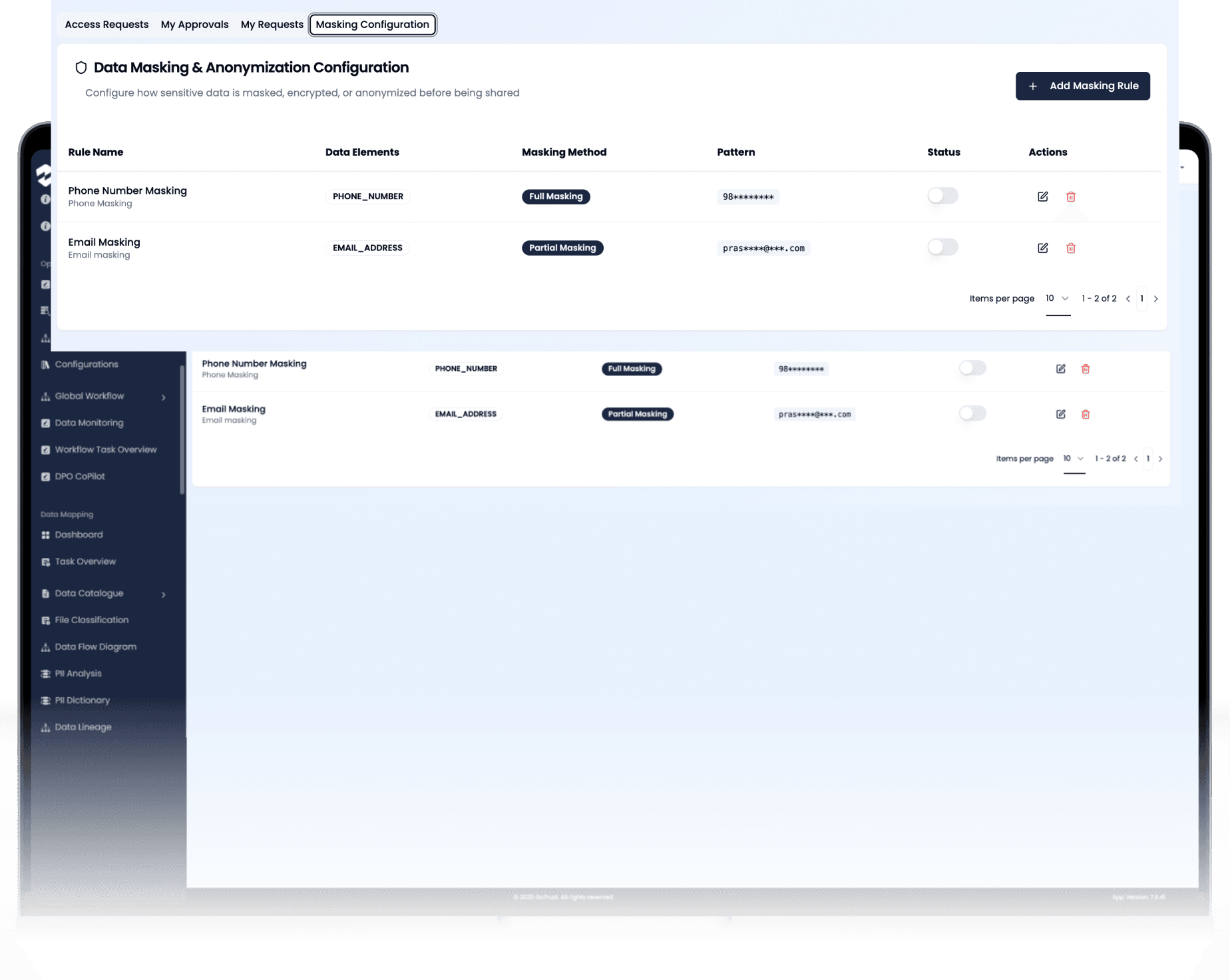
Dynamic Data Masking
Mask sensitive values in real time based on user role, request context, and access policy.
Data Provisioning
Automate controlled dataset delivery to authorised users based on governance policies — every provision is role-scoped, logged, and revocable.
Data Fabrication
Generate statistically faithful synthetic datasets that mirror real data distributions and edge cases — with zero personal data in the output, eliminating re-identification risk entirely.

Policy-Driven Access
Grant or restrict dataset access using fine-grained governance policies tied to user roles, departments, and data classification levels.
User-Scoped Delivery
Automatically tailor the dataset view each user receives — masking, filtering, or truncating fields they are not permitted to see.
Continuous Monitoring
Track every provisioning event in real time with alerts for anomalous access patterns, bulk downloads, or policy violations.
Seamless Integration
Connect to your existing data catalog, identity provider, and warehouses. Provisioning policies apply across all connected sources.
Audit-Ready Logs
Generate compliance-ready reports on all data access events, exportable for GDPR, HIPAA, or internal audit requirements.
Time-Bound Permissions
Set expiry windows on data access grants. Permissions automatically revoke after the defined period, reducing standing exposure.
Privacy Enhancement Techniques activate automatically across your data lifecycle.
Step 1 — Data Ingestion
Raw data enters GoTrust from source systems via connectors or APIs.
Step 2 — Classification
Fields are automatically classified by sensitivity level using detection rules and ML tagging.
Step 3 — Policy Application
PET rules are applied — anonymization, masking, minimization — based on data class and context.
Step 4 — Provisioning
Processed data is provisioned to authorized users within their permitted scope.
Step 5 — Audit & Review
Every action is logged. Compliance reports are generated continuously and on demand.