Assessment Management represents a formalised and repeatable process through which organisations evaluate privacy risks and the lawfulness of data processing activities. It encompasses structured assessments such as Privacy Impact Assessments (PIAs), Legitimate Interest Assessments (LIAs) and Transfer Impact Assessments (TIAs). These evaluations serve as foundational pillars for compliance programmes, enabling organisations to document risk decisions, justify lawful bases, and evidence accountability to regulators, auditors and data subjects.

You
Modern regulatory frameworks increasingly require demonstrable due diligence and transparent decision making. Assessment Management facilitates this obligation by ensuring every high-risk processing activity is reviewed, documented and justified through a controlled workflow. This strengthens internal risk governance while supporting consistent compliance with evolving data protection obligations.
Historically, privacy assessments were often conducted informally, managed through email chains, unstructured documents and spreadsheet trackers. Such decentralised approaches lead to gaps in visibility, inconsistent evaluation standards, and limited audit trails.

Regulated industries are transitioning toward comprehensive assessment governance, driven by factors such as:
1. Rising enforcement and scrutiny over privacy risk management controls .
2. Global data protection laws emphasising documented accountability .
3. The need for defensible privacy decision making frameworks.
4. Growing organisational dependency on data driven operations and automation .
A structured assessment management model introduces a repeatable and transparent mechanism for identifying privacy risks, assigning responsibility, tracking decisions and demonstrating compliance maturity. This transition reflects the evolution from manual compliance to integrated privacy governance architecture anchored in risk, evidence and traceability.
How the Solution Works
A well-designed assessment management system establishes a lifecycle for evaluating data processing operations, typically incorporating the following elements:
Central Compliance Dashboard
A single interface presents an overview of assessments, their status, applicable regulatory requirements and readiness levels (PIA, LIA, TIA). This assists privacy leadership in maintaining situational awareness and reporting progress to executive and audit stakeholders.
Pre-Defined Assessment Workflows
Workflows outline the prescribed steps for each assessment category, ensuring consistency in methodology. Standardised processes also reduce subjectivity and prevent gaps caused by ad hoc approaches.
Assessment Ownership and Responsibility Mapping
Each assessment is attributed to a designated responsible individual, promoting accountability, timely completion and clarity in governance responsibilities.
Specialised Questionnaires and Templates
Regulation aligned questions guide users through key considerations, ensuring evaluations are comprehensive, legally aligned and factually documented. This enables non technical stakeholders to participate without compromising rigour.
Collaborative Review and Validation
Cross functional involvement is supported, allowing privacy officers, legal counsel, security leaders and business teams to participate in structured review and approval cycles.
Audit Trails and Record Keeping
Time stamped activity logs preserve documentation for regulatory inquiries, internal audits and compliance certification processes. These logs form proof of compliance aligned decision making and due process adherence. Through these capabilities, organisations benefit from audit ready documentation, defensible outcomes, consistent decision standards and increased transparency across the privacy compliance lifecycle.
How GoTrust Supports Organisations
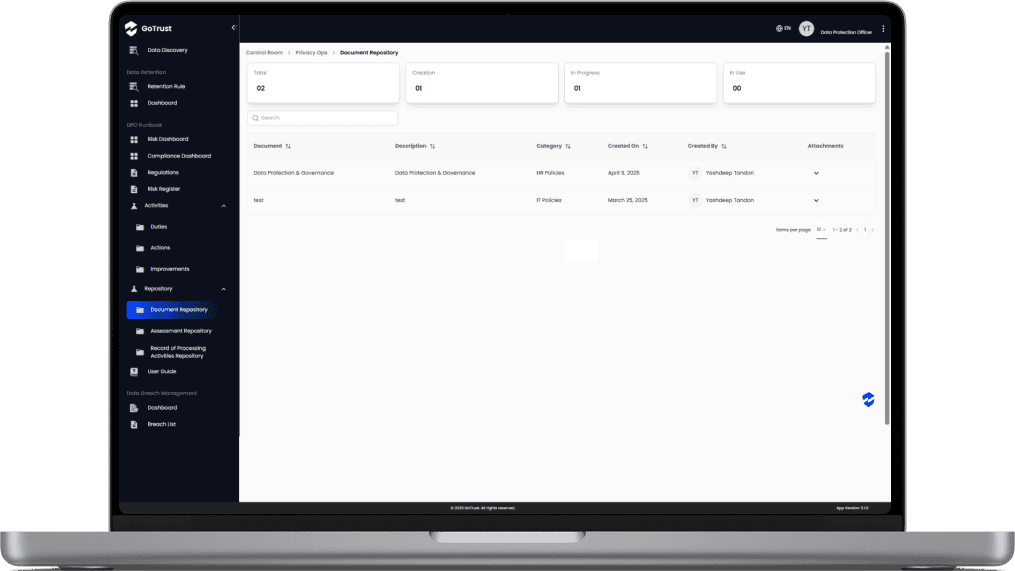
GoTrust provides a unified interface that enables organisations to operationalise, standardise and scale their assessment programmes. Key capabilities include:
1. Central storage of all assessment artefacts, reducing fragmentation and manual record management .
2. Automated process routing and structured assignment of accountability.
3. Regulation aligned templates designed to streamline assessment execution and reduce ambiguity .
4. Real time dashboards supporting strategic insights, maturity visibility and executive reporting .
5. Detailed audit trails that demonstrate traceability and reinforce organisational accountability .
These functionalities support legal, privacy and compliance teams in establishing a reliable governance framework, enhancing efficiency and maintaining regulatory aligned documentation for scrutiny or certification exercises.
How GoTrust Platform Stands Out
GoTrust distinguishes itself by focusing specifically on privacy assessment needs rather than general compliance checklists. It incorporates structured workflows, clear role assignment, automated record keeping and targeted assessment templates for PIAs, LIAs and TIAs. This results in a consistent, defensible assessment lifecycle aligned with regulatory expectations and organisational governance requirements. The outcome is a repeatable and transparent assessment process that supports evidence driven compliance, minimises operational gaps and promotes an embedded culture of privacy accountability.
Ready to get started?
Request a free demo today to see how GoTrust can guide your trust transformation journey
GoTrust Knowledge Hub
Stay informed with insights, updates, and expert perspectives on data privacy, compliance, and digital trust.


Frequently Asked Questions (FAQ)
What is a data governance framework?
How do I choose the right data framework?
Can a governance framework help with compliance?
What is the difference between data governance and data management?
How does a data governance framework support data security?