SIM-Binding Rule to Change How WhatsApp and Telegram Work in India from March 1st
India’s new SIM-binding rule effective March 1 will change how WhatsApp and Telegram operate. Learn what this regulation means for messaging apps, user privacy, and digital security.
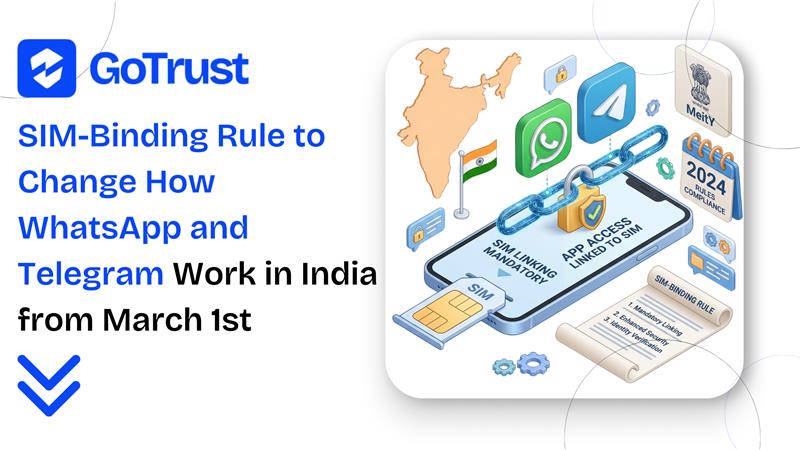
India is enforcing a new SIM-binding rule starting on March 1, 2026. This rule fundamentally changes how popular messaging apps like WhatsApp, Telegram, and Signal work, especially when used on multiple devices and web clients.
The new Telecom Cyber Security Rules say that these apps must always check that the original, KYC-verified SIM used to sign up is still in the main device and working. If the SIM is taken out, switched, or turned off, the app must stop working, even over Wi-Fi.
The Department of Telecommunications’ AI & Digital Intelligence Unit ordered major messaging platforms in November to implement SIM binding within 90 days, with non‑compliance exposing providers to legal action under the Telecommunications Act 2023 and the Telecom Cyber Security Rules. A key operational change is mandatory six‑hour auto‑logout for services like WhatsApp Web and Telegram Web, forcing users to periodically re‑link sessions via their SIM‑bound primary phone, significantly constraining always‑on multi‑device workflows.
The government argues the move is “the need of the day,” citing cyber‑fraud losses and the widespread misuse of over‑the‑top messaging accounts for phishing, loan scams, and “digital arrest” schemes, while industry groups question whether such deep technical mandates exceed DoT’s statutory powers and create new privacy and competition concerns.
📰 MINI HEADLINES
India’s Space Sector Gets Cybersecurity Boost with New CERT-In–SIA Guidelines
India has released its first set of Space Cyber Security Guidelines, which were created by CERT-In and the Satcom Industry Association of India to protect satellites, ground stations, and space supply chains from growing cyber threats. The advisory framework, which was shown off at DefSat 2026 in New Delhi, includes "defence in depth, breadth, and height" principles, controls for each segment, and clear responsibilities for all stakeholders. This shows that cybersecurity is now a key part of India's space strategy instead of just a technical detail.
Middle East Conflict Prompts GCC Rethink, Strengthens India’s Position As a Safer Tech Hub
Global capability centres are compelled to reconsider their plans for expansion in the Gulf due to the escalating tensions and cyber-physical risks in the region. Some organisations are thinking about halting or diversifying their regional footprints. Despite short-term uncertainty and financial concerns, India is increasingly seen in this recalibration as a relatively safe and stable location for long-term tech and GCC investments.
OpenAI Amends Pentagon Contract to Explicitly Bar Domestic Surveillance and Intelligence Agency Use
OpenAI CEO Sam Altman announced significant amendments to the company's defence contract with the US Department of Defence, explicitly prohibiting its AI models from being used for domestic surveillance of US persons or by intelligence agencies like the NSA without a separate, specially negotiated contract. The changes came after widespread backlash over OpenAI's initial agreement to deploy its technology within classified Pentagon networks, with critics raising alarms about potential mission creep into surveillance applications. Altman stated the company would "rather go to jail" than enable unlawful surveillance while maintaining support for "all lawful military uses", including cybersecurity defence, logistics optimisation, and battlefield analytics, signalling a deliberate boundary between acceptable defence applications and constitutionally problematic intelligence work.