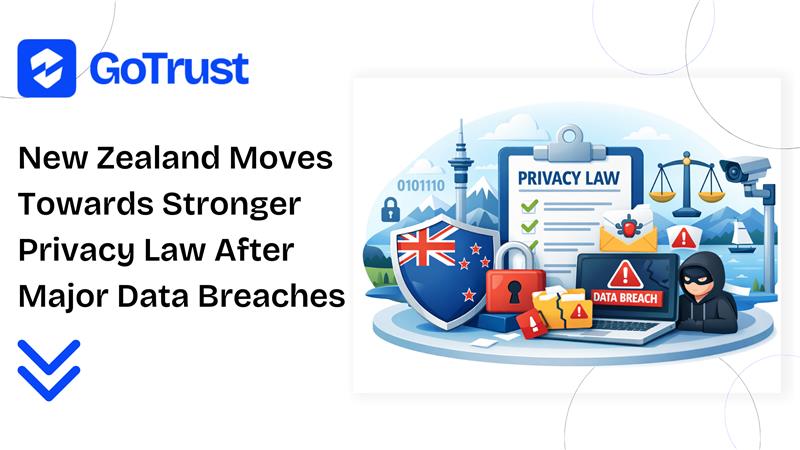
New Zealand Moves Towards Stronger Privacy Law After Major Data Breaches
New Zealand moves to strengthen privacy laws after major data breaches, aiming to improve data protection, accountability, and security for businesses and citizens.
As a series of headline-grabbing cyber incidents exposes the limitations of its current framework, New Zealand is steadily progressing toward a substantial upgrade of its Privacy Act 2020. Public outrage and a growing consensus among policymakers that the current tools, notifications, guidance, and reputational pressure are insufficient to alter behaviour have been sparked by significant breaches that have affected government agencies, healthcare providers, and large private organisations. These breaches have exposed highly sensitive personal data.
The Privacy Commissioner, Michael Webster, has repeatedly stated that the Office of the Privacy Commissioner lacks strong enforcement tools when compared to peers in jurisdictions such as the EU, the United Kingdom, and Australia. Currently, the regime relies on conciliatory approaches and Human Rights Review Tribunal proceedings, which are slow, resource-intensive, and unsuitable for the fast-paced nature of modern cyber incidents. This has fuelled calls from legal experts and civil society for a shift away from a primarily educational model and toward one that incorporates real deterrence via timely regulatory interventions.
Policy discussions are now focusing on a few specific reforms. The Privacy Commissioner can impose administrative fines based on an organisation's turnover and the severity of the breach, as there is strong support for implementing GDPR-style penalties. Second, stakeholders are advocating for clearer, more prescriptive security obligations, particularly for entities handling health, financial, or biometric data. This includes explicit expectations for governance, vendor due diligence, encryption, and regular control testing. Proposals include tightening breach notification rules (shorter timelines, more technical detail, and clearer thresholds) to prevent under-reporting and "carefully worded" notifications that do not accurately reflect the impact on affected individuals.
The debate has expanded to include cross-border data transfers and alignment with global standards. Commentators argue that New Zealand's law should be interoperable with GDPR and other high-standard regimes to maintain adequacy and business confidence, as the country positions itself as a trusted destination for cloud services, digital government, and cross-border research. Stronger rules for onwards transfers, processor accountability, and risk assessments for offshore hosting are seen as critical to ensuring that protections "travel with the data" rather than stopping at the border, as these measures would help align New Zealand's data protection framework with international standards and enhance user trust in digital services.
The reform initiative is framed as a matter of trust and legitimacy, in addition to technical compliance. The willingness of citizens to share data with public institutions and the support for digital-first service delivery may be undermined by repeated breaches that fail to result in visible, credible consequences. The implementation of a single, high-water-mark privacy program across markets would be facilitated by a more stringent New Zealand regime, which would simultaneously reduce fragmentation and raise the compliance bar for global organisations. In that regard, the current wave of breaches may serve as a turning point, transforming New Zealand's privacy law from a relatively soft-edged, principles-driven framework to a more sharp-edged, enforcement-capable regime that more closely resembles leading international standards.
📰 MINI HEADLINES
Western Coalition Launches 6G Cybersecurity Guidelines
The Global Coalition on 6G (GCOT), led by cybersecurity authorities from the US, UK, Canada, Australia and New Zealand, has released the first comprehensive cybersecurity guidelines for next generation 6G networks. The framework addresses supply chain risks, network slicing security, quantum-safe encryption and AI-driven threat detection, aiming to pre-empt vulnerabilities before 6G deployment accelerates in the early 2030s.
Read More → https://www.infosecurity-magazine.com/news/gcot-6g-cybersecurity-guidelines/
Hacktivists Launch Retaliatory Cyberattacks After U.S.–Israel Strikes on Iran
Following the joint US-Israeli strikes, hacktivist groups launched a barrage of retaliatory cyberattacks on Iranian apps, websites, and infrastructure, including notable defacements on the popular Bade Saba religious app (5 million+ downloads) and several state media sites. The operations, claimed by pro-Israeli actors, featured politically charged messages and data leaks. Cybersecurity firms warn of potential escalation as Iranian-aligned groups like APT33 remain quiet but active on reconnaissance.
TikTok Won’t Protect DMs With Controversial Privacy Tech, Citing User Risks
TikTok has rejected implementing end‑to‑end encryption (E2EE) for direct messages despite internal research showing it could enhance privacy, arguing that the technology would hinder child safety efforts by blocking detection of grooming, CSAM, and other harms. (see the generated image above) The company’s decision, revealed in documents from ongoing regulatory scrutiny, prioritises proactive moderation over cryptographic protections, drawing criticism from privacy advocates who argue it undermines trust and exposes users to surveillance risks.
Read More → https://www.bbc.com/news/articles/cly2m5e5ke4o