Article by
Introduction
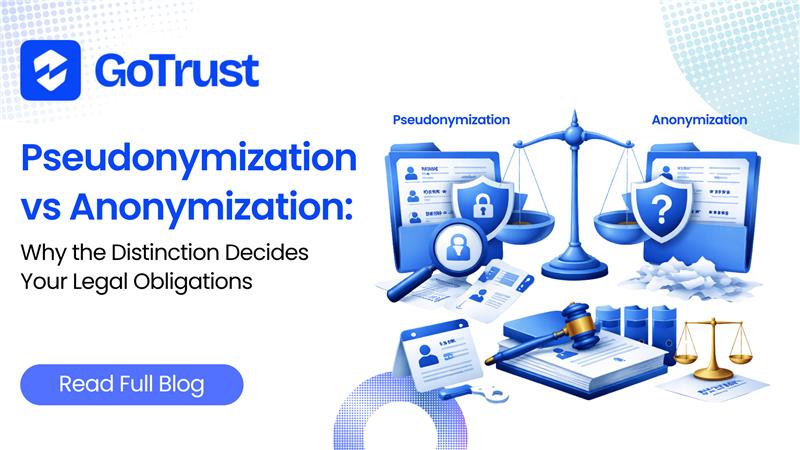
The distinction between pseudonymization and anonymization is critical, as it defines an organisation’s legal obligations under India’s Digital Personal Data Protection (DPDP) Act, 2023. Data Fiduciaries often treat these techniques as interchangeable, but they have fundamentally different regulatory consequences. Pseudonymized data remains personal data and is subject to all DPDP requirements, including consent, data subject rights, retention limits, breach notification, and Data Protection Board oversight. In contrast, truly anonymized data falls entirely outside the Act’s scope. Organisations can avoid compliance obligations only if anonymization is irreversible and identification is impossible.
This distinction is substantive, not merely semantic. It determines whether a dataset must comply with consent and purpose limitation rules, whether Data Principals can exercise erasure rights, if cross-border transfers require safeguards, and whether cross-border transfers require safeguards, and whether detailed breach reports must be submitted if detailed reports of breaches must be reported within 72 hours under Rule 7 of the DPDP Rules, 2025 (or longer if extended by the board). The DPDP Act defines personal data in Section 2(t) as “data about an individual who is identifiable by or in relation to such data.” If identifiability persists, either directly or through other available information, the data remains personal regardless of any obfuscation techniques.
Aspect | Pseudonymization | Annonymization |
Reversibility | Replace identifiers with tokens; re-identification possible with key | Irreversibly eliminates all identifiability |
Consent Required | Reversible using separately stored mapping/key | Irreversible: no re-identification pathway exists |
Legal status | Personal data subject to full DPDP obligations | Not personal data; exempt from DPDP framework |
Data Principal Rights | Fully applicable (Sections 11-13: access, correction, erasure) | Not applicable: cannot link to identifiable individuals |
Breach Notification | Required to be done immediately and for the detailed breach report within 72 hours (Rule 7) | Not required: no personal data breach |
Retention limits | Applies with mandatory deletion after purpose fulfilled (Rule 8) | No limits: can retain indefinitely |
Cross-Border Transfer Restrictions | Subject to Central Government notified restrictions | No restrictions: can transfer globally |
Re-Identification Risk | High: vulnerable to record linkage, auxiliary data attacks | Low/No risk when properly implemented and validated |
Data Utility | High: preserves granular detail and longitudinal tracking | Variable: aggregation reduces granularity but preserves trends |
Implementation on complexity | Moderate: requires secure key/mapping management | High: requires rigorous motivated intruder testing |
The DPDP framework’s treatment of each, analyses re-identification risks using the “motivated intruder” test, and demonstrates how GoTrust’s data platform supports defensible de-identification at scale.
Defining Pseudonymization: Reducing Identifiability Without Eliminating It
Pseudonymization is a data transformation technique that replaces direct identifiers such as names, email addresses, telephone numbers or national identification numbers with pseudonyms or tokens. The European Union’s General Data Protection Regulation (GDPR) defines pseudonymization in Article 4(5) as “the processing of personal data in such a manner that the personal data can no longer be attributed to a specific data subject without the use of additional information, provided that such additional information is kept separately and is subject to technical and organisational measures.”
Operationally, pseudonymization breaks the direct link between a dataset and an individual’s identity but preserves the ability to re-identify if needed. The common Pseudonymization Techniques (4 Forms):
Masking: Replaces specific parts of data with fixed characters (e.g., XXXX-1234 for credit card numbers, name → N\\\ S\\\\). Preserves format but obscures sensitive portions.
Hashing: Applies cryptographic hash functions (SHA-256, MD5) to identifiers. One-way transformation; collision-resistant but vulnerable to rainbow table/dictionary attacks on low-entropy data like names/DOB combinations.
Tokenization: Replaces sensitive data with randomly generated tokens while maintaining a secure lookup table for reversibility. Tokens preserve data length/format for system compatibility (e.g., 16-digit token for PAN).
Format-Preserving Encryption (FPE): Encrypts data while preserving original format/length (e.g., 16-digit number → another 16-digit number). Reversible using encryption key; ideal for legacy systems requiring fixed formats.
Because pseudonymized data remains identifiable to the entity holding the key, it is subject to all DPDP obligations. Data Fiduciaries must obtain consent or rely on other lawful grounds, respect Data Principal rights, implement Rule 6 safeguards, maintain audit trails, and report breaches. While pseudonymization reduces risk in case of unauthorized access, it does not alter the legal status of the data for any entity able to re-identify individuals.
Defining Anonymization: Irreversible Elimination of Identifiability
Anonymisation is a data technique that permanently eliminates all identifiability. Truly anonymized data cannot be linked back to any individual, even when combined with other reasonably available information. The key is irreversibility: there is no mapping or reversal mechanism, and no feasible way to re-identify individuals using additional information.
Legal analysis agrees: anonymized data from which identification is impossible is not considered personal data under Section 2(t) and is not subject to DPDP obligations.
Aggregation: Combining individual records into summary statistics or grouped data that report trends across populations rather than individual values. For example, reporting “35% of patients aged 40-50 reported symptom improvement” rather than individual patient outcomes.
Generalisation: Reducing the precision of data elements to broader categories that prevent singling out individuals. Examples include replacing exact ages with age ranges (e.g., “45-54” instead of “47”), precise locations with regions (e.g., “Bangalore urban district” instead of specific postal codes) and exact dates with months or years.
Data masking: Obscuring portions of identifiers by replacing them with placeholders or generic values, rendering them non-identifying whilst preserving format for analytical purposes (e.g., masking all but the last four digits of account numbers).
Differential privacy: Applying mathematical techniques that guarantee individual records do not significantly influence query results, enabling statistical analysis whilst providing provable privacy guarantees even against adversaries with auxiliary information. Introducing controlled statistical randomness to numerical data, obscuring individual values whilst maintaining overall distributional properties and aggregate statistical validity. This technique is particularly valuable for numerical datasets where exact values are sensitive but aggregate patterns remain analytically useful.
Types of Anonymity: k-Anonymity, l-Diversity, and t-Closeness
Anonymization encompasses several formal privacy models that build upon the basic concept of making data non-identifiable. While k-anonymity provides a foundational approach, its limitations have led to more sophisticated techniques such as l-diversity and t-closeness.
k-Anonymity : Ensures each record in a dataset is indistinguishable from at least k-1 other records with respect to quasi-identifiers (QIDs). This is achieved through generalisation and suppression techniques that group similar records into equivalence classes. However, k-anonymity suffers from homogeneity attacks (all sensitive values in an equivalence class are identical) and background knowledge attacks (adversaries using external data to narrow down groups).
l-Diversity addresses k-anonymity’s homogeneity vulnerability by requiring that each equivalence class contains at least l “well-represented” values for the sensitive attribute. This prevents scenarios where all records in a group share the same sensitive outcome (e.g., all having “high salary” or “heart disease”). Common variants include:
Distinct l-diversity: l distinct sensitive values per group
Entropy l-diversity: Entropy of sensitive values exceeds threshold l
Recursive (c,l)-diversity: Prevents probabilistic inference attacks
t-Closeness further strengthens protection against background knowledge attacks by ensuring the distribution of sensitive values in each equivalence class has Earth Mover’s Distance (EMD) ≤ t from the overall dataset distribution. This prevents attackers from inferring sensitive attribute values even when they possess demographic statistics about the population.
The Motivated Intruder Test: Assessing Anonymization Robustness
A practical framework for evaluating whether anonymization is effective is the ‘motivated intruder test’. This test asks whether a reasonably competent and motivated person, using available resources and techniques, could re-identify individuals from the anonymized dataset. The test does not assume an adversary with unlimited resources, insider access or illegal capabilities, but rather someone with:
Publicly available information and data sets
Reasonable technical competence in data analysis and linkage
Motivation to re-identify individuals (for example, journalists investigating public figures, competitors seeking business intelligence or malicious actors targeting specific individuals)
Willingness to invest time and effort, but not unlimited computational resources or unlawful means such as hacking
Organisations should apply this test by documenting:
The nature of the dataset: What attributes are included? How rare or unique are combinations? Does the dataset include uncommon medical conditions, rare occupations, or other distinguishing characteristics that could facilitate re-identification?
Auxiliary data availability: What other datasets are publicly available or could reasonably be obtained that might enable linkage? This includes government databases, social media profiles, public records, commercial datasets and previously published research data.
Geographical and temporal context: Does the dataset include small geographical areas or time periods that could narrow the population to a small number of individuals? Even generalised locations can become identifying when combined with rare attributes.
Data linkage: Could a motivated intruder plausibly link records across datasets using common attributes? This requires assessment of whether sufficient quasi-identifiers overlap between the anonymized dataset and available auxiliary data.
GoTrust’s governance framework supports structured motivated intruder assessments by documenting the dataset characteristics, auxiliary data landscape, linkage risks and risk mitigation measures. These documented assessments provide audit-ready evidence that anonymization decisions were made rigorously and defensibly.
Legal Obligations That Hinge on the Distinction
The distinction between pseudonymization and anonymization is not academic; it determines the applicability of every substantive obligation under the DPDP framework.
Consent and Lawful Basis: Pseudonymized data requires a lawful basis for processing, typically consent under Section 6 or one of the specified legitimate uses in Section 7. Data Fiduciaries must provide standalone, clear consent notices specifying the purpose, data categories and withdrawal mechanisms. Anonymized data, because it is not personal data, requires no consent and is not subject to purpose limitation. Organisations can process, share and re-use truly anonymized data freely without engaging the DPDP framework.
Data Principal Rights: Sections 11 through 13 of the DPDP Act establish Data Principal rights: access, correction, erasure and grievance redressal. These rights apply to personal data, including pseudonymized data. If a Data Principal submits an erasure request under Section 12, the Data Fiduciary must delete pseudonymized records linked to that individual, even if those records are held in tokenised or coded form. GoTrust’s automated data subject rights workflows trace pseudonymized identifiers back to Data Principals and execute deletion across all systems where that pseudonym appears.
Security Safeguards and Breach Notification: Rule 6 of the DPDP Rules mandates reasonable security safeguards for personal data, including encryption, obfuscation, access controls, logging and monitoring. Pseudonymized data remains subject to these requirements. If unauthorised access occurs, the Data Fiduciary must assess, whether a reportable breach has occurred and, if so, notify the Data Protection Board of India and affected Data Principals with a comprehensive detailed breach report, within 72 hours under Rule 7.
Retention and Deletion: Rule 8 establishes retention and deletion requirements for personal data, including a 48-hour advance notice obligation before erasure in certain contexts and mandatory deletion once the processing purpose is fulfilled. Pseudonymized data is subject to these rules. GoTrust’s retention automation tracks pseudonymized data age, issues deletion notices and executes erasure workflows when retention periods expire.
Re-Identification Risk: The Operational and Legal Hazard: The most significant risk in deploying pseudonymization or anonymization techniques is misjudging the boundary between them. Data Fiduciaries frequently assume that applying pseudonymization renders data “anonymous” when, in fact, identifiability persists through re-identification vectors. It includes:
Record linkage: Matching records across datasets using overlapping quasi-identifiers, even when those attributes are individually non-identifying. An adversary might link a medical research dataset (containing age range, postal district, diagnosis) with publicly available voter registration data (containing exact age, address) to re-identify participants.
Attribute inference: Deducing identities from rare or unique combinations of attributes. A dataset reporting “male patient, aged 82, diagnosed with a specific rare genetic disorder in postal district 560001” may uniquely identify a single individual even without explicit identifiers.
Pattern matching: Identifying individuals through temporal, spatial or behavioural patterns that are distinctive. Location trajectories, even when generalised, may reveal home and workplace locations that narrow the population to a small set of individuals.
Auxiliary data exploitation: Leveraging external data sources social media profiles, public records, commercial databases, previously published research to augment the information available for re-identification attempts.
Section 17(2)(b) of the DPDP Act provides a partial exemption for processing personal data for research, archiving, or statistical purposes, conditioned on ensuring that “the identity of the Data Principal cannot be inferred from such data.” This language establishes a strict non-identifiability threshold. Simply pseudonymizing data is insufficient; organisations must implement de-identification measures robust enough that inference of identity becomes infeasible.
Implementing Defensible De-Identification Strategies
Organisations seeking to leverage anonymization for regulatory relief must adopt rigorous, documented de-identification strategies rather than ad hoc obfuscation.
Step 1: Data Discovery and Sensitivity Classification: Effective de-identification begins with comprehensive visibility. Organisations must identify all personal data, classify it by sensitivity and map data flows before determining which data sets are candidates for anonymization. GoTrust’s data discovery engine scans structured and unstructured data across on-premises, cloud and hybrid environments, detecting personally identifiable information using AI-driven pattern recognition. Discovered data is automatically classified into sensitivity tiers, enabling organisations to prioritise anonymization efforts on high-risk data sets.
Step 2: Purpose and Use Case Assessment: Not all data requires full identifiability for legitimate business purposes. Analytics, trend analysis, machine learning model training and research often derive value from aggregate or de-identified data. Organisations should assess which processing activities genuinely require personal data and which can be satisfied with anonymized data sets. GoTrust’s data mapping capabilities document the business purpose for each data set, enabling informed decisions about where anonymization can substitute for personal data processing.
Step 3: Technique Selection and Application: Different use cases demand different de-identification approaches. Statistical reporting may benefit from aggregation and generalisation. Machine learning training data may require differential privacy or k-anonymity. Clinical research may necessitate a combination of generalisation, noise addition and suppression of rare attributes. Organisations should select techniques appropriate to the data type, analytical requirements and threat model.
Step 4: Motivated Intruder Assessment: After applying anonymization techniques, organisations must conduct formal motivated intruder assessments. This involves evaluating what auxiliary data is available, what linkage techniques could be deployed and whether unique combinations of quasi-identifiers persist. GoTrust’s governance framework supports documented assessments, capturing assumptions, methodologies and conclusions. These assessments should be reviewed periodically, particularly when new auxiliary data becomes available or when computational de-anonymization techniques advance.
Step 5: Governance and Continuous Monitoring: Anonymization is not a one-time process. As external conditions change new data sets are published, linkage algorithms improve, regulatory guidance evolves previously robust anonymization may become vulnerable. Organisations should establish review cycles for anonymized data sets, reassessing re-identification risk annually or when material changes occur. Data Protection Impact Assessments (DPIAs) should be conducted when anonymization is deployed as part of high-risk processing activities.
GoTrust’s compliance automation schedules periodic reviews and flags anonymized data sets approaching revalidation dates, ensuring that anonymization governance remains current and defensible.
Conclusion
Pseudonymized data remains personal data, carrying the full weight of consent, Data Principal rights, security safeguards, breach notification, retention limits and cross-border transfer restrictions. Anonymized data, when irreversibly stripped of identifiability, falls outside the DPDP framework entirely, offering organisations operational flexibility and regulatory relief provided the anonymization is robust, assessed rigorously using frameworks such as the motivated intruder test, documented comprehensively and periodically revalidated.
GoTrust’s data discovery, classification and governance platform provides the operational infrastructure necessary to navigate this distinction at scale. By automating identification, classification, de-identification workflow orchestration, motivated intruder assessments and periodic revalidation, GoTrust enables organisations to deploy pseudonymization and anonymization defensibly, transparently and sustainably. In a regulatory environment where identifiability is the definitive criterion for personal data status, precision in de identification is not optional it is foundational to lawful data governance.
Found this useful? Share it.